Showing posts with label oolong. Show all posts

Friday, March 23, 2012

Tea, Time and Porcelain: Wu Yi Shui Hsien Traditional 2010 After Fourteen Months


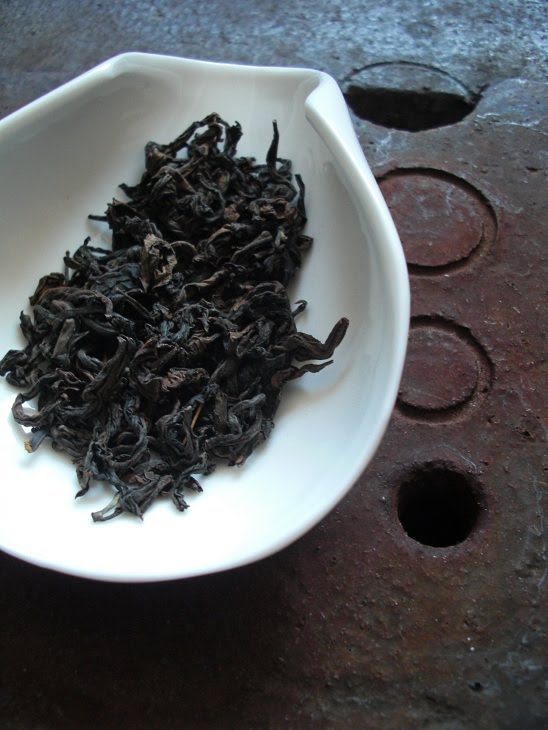
Today, out of an unexplainable inner need, I opened a jar of 2010 Traditional Wu Yi Shui Hsien, was purchased from one of my favorite Czech tea vendors LongFeng at the beginning of February 2011 and, since then, rested in a wax-sealed jar. Back then, when it was fresh, it already was a very solid , traditional Yancha – originating in inner Wu Yi, grown at elevation of about 800 meters above the sea level, completely hand-made and roasted over hard-wood charcoal.

In fresh state, its taste was already very pure and remarkable, though still somehow fiery and roasty – not in a bad way, though still impossible not to notice - a major nuance in this tea's typical character.

Yet, I was wondering – how would this taste evolve, if I let the leaves rest for a while? Until next winter, maybe?

In the end, I haven't opened this jar in winter. Strangely, the usual need to drink darker rock oolongs, which have accompanied me almost every fall and winter of my tea-life so far, almost haven't appeared this year.

What might seem even stranger – but still feels right – is that this need appeared today. On a sunny, warm day at the beginning of spring. All of sudden, I just felt it's the time to open this jar and pour these leaves into the teapot once again.


Just a quick note, since I don't really want this to be a traditional tea-tasting post: these leaves really did change. A year spent in porcelain without any access to air or light made the fiery roastiness almost disappear, moving its character more into the field of sweet, fruity deepness, dried plums and caramel-like creaminess.

This tea, with its warming, mineral character, feels somehow special and definitely unusual on a day which is equally warm itself.

It is not typical at all for me to drink such tea in spring; but today, it just feels right. For some reason, it feels like this is the tea I was longing for. And for me, that is what matters most.

Usual day, made unusual by an encounter with a personal little year-old tea experiment.


Saturday, August 13, 2011

2011 Kim Jong Yeol's Balhyocha Noeul Hyanggi “Sunset”


Today's weather isn't exactly green. The sky is cloudy, air quite breezy and it occasionally rains – somehow, it feels like this is the day I've been awaiting to open this special tea.

This season, Teamountain offers two yellow teas made by tea master Kim Jong Yeol (and it seems like one made by Kim Shin Ho is on the way as well), named poetically “Sunrise” and “Sunset”. I purchased Sunset on my visit to Brno's Sklenena Louka teahouse, owner of which also told me her impressions of these teas – while Sunrise is more chocolate-like and dark, Sunset is supposed to be more spicy and somehow reminiscent of Taiwanese Bai Hao oolong. While I haven't bought both of these teas and, therefore, will not be able to compare them in a similar way, I'd very much looked forward to trying Sunset on its own.

The origin of this fermented tea is Yonggang-Ri, Hwagae-myeon, Gyeongnam, it was picked during the second week of May and is made of wild, approximately 20 years old tea bushes.


This simple, yet beautiful packaging is opened and immediately releases intensive, deep smell of meadow flowers, honey and cinnamon. In terms of appearance, Wuyi Yancha is the first thing that comes to my mind; these leaves are dark with shades of black and brown, curly and mostly unbroken. When placed into the preheated teapot, their aroma intensifies even more, now being even sweeter and revealing a slightly roasty, bread-like note.


The first infusion is brewed with freshly boiled water and is orange-golden in color, still retaining the deep smell of dry leaves. Its taste is equally deep and sweet, offering countless tones, both those already revealed in smell as well as many new – dried fruit, particularly apricots, honey, flowers, cinnamon-like spiciness and very subtle, refined roast. Immediately after the first sip, this tea feels strong – not in a way of being over-brewed or too harsh (the exact opposite is true – this tea is very mild and noble), but it seems to have strong, warming and yet calming energy, which is impossible not to notice. This infusion also has expectably long and vivid aftertaste, filling the throat with subtle deep sweetness.

The second infusion is slightly darker orange in color, very transparent and very aromatic. Honey, fruit, meadow flowers and cinnamon remain the main tones, though they now seem to have a bit different mouthfeel – even deeper and smoother. There isn't a single trace of bitterness in this brew, instead, it fills mouth with various tones of ripe and dried fruit, seemingly alternating and complementing each other. The aftertaste of this infusion is more pronounced and even warmer than that of the first brew, evolving over time and becoming sweeter and sweeter.


The third infusion returns to the lighter orange-golden color of the first one, though its taste remains similar to the second brew, being very fruity, sweet and slightly spicy, now revealing a new tone as well – citrus-like juiciness, which overtakes the aftertaste as well – a bit like warm orange or lime with honey.

This citrus-like note gradually becomes dominant in the fourth, fifth and sixth infusions, though most of the other fruity and sweet tones remain present as well – just not as dominant as before, now they seem to be hidden under the main citrusey nuances. All of these brews retain the significantly warm, calming energy, detectable primarily in the long aftertaste.


With its clear, deep character and warm, remarkably soothing energy, this Balhyocha makes a simple session feel like a very special, important occasion. Its lyrical name Sunset seems to be very well chosen – it really has power to create the atmosphere of a calm, silent evening on a meadow inside a wild forest, watching the sun going down slowly; all that in a single cup, even in the heart of a city.


Friday, March 4, 2011

2010 Gokuchanin Hanhakoucha Choucho


This tea interested me from the first moment when I saw it in Teamountain's offering – another of Gokuchanin's oolongs, once again inspired by famous non-Japanese tea. While the main inspiration of previously mentioned Hanhakoucha Tefutefu was Taiwanese Oriental Beauty, in case of Choucho, it's a whole category if teas - Yancha from Wu Yi. This tea is made of Sayamakaori cultivar, which is quite typical for its native Saitama prefecture. When I saw it in offering of Slovak shop Nomad some time later, I had no doubts and purchased it immediately.


The dry leaves really are reminiscent of Wu Yi oolongs – they are mostly brown, quite dark and curly, though generally a bit shorter than regular rock teas. However, the first big difference can be observed in their smell – very fruity, fresh, light and somehow typically for Gokuchanin's Hanhakoucha in general. They share some notes with Tefutefu as well and, more surprisingly, also with Korean Yellow tea – very interesting indeed. There are no vivid roasty or nutty chocolate tones typical for Yancha.


The first infusion is golden yellow in color, very clear, refined and fruity in taste with dominant tones of sweet, ripe apples and apple juice, plums and a slight umami undertone. The taste is very complex, harmonic and mouthfilling, yet light and refreshing with long, spicy aftertaste lingering on tongue with mild, yet vivid ripe fruity tones.

The second infusion, though brewed for a shorter amount of time, has darker, pure orange color (very whiskey like). It's also a bit more intensive in taste, even more fruity than the first infusion, less refreshing and more warming; still, the tea keeps its noble complexity with dominant fruitiness and, in this infusion, also a hint of pleasant creaminess and citrus fruit. The aftertaste gets even longer after this infusion, being very apple-like and gradually becoming sweeter and sweeter.


The third infusion gets even more orange, though still preserving the clear transparency in color; the taste is very similar to that of the previous brew, just a bit more spicy, intensive and mouthfilling. The creaminess is significantly stronger in this infusion, contributing to the noble smoothness and repressing any possible astringency.

In terms of color, the fourth and fifth infusions are very similar to the second one, while in taste, they are still just as intensive as the third brew – smooth, fruity and a bit citrus-like, still very sweet, warm and creamy with long, spicy aftertaste. This character continues through the sixth and seventh infusion, before the tea starts losing its complexity.


In my eyes, Hanhakoucha Choucho proves that Gokuchanin is not trying to copy the famous original teas and instead just takes some inspiration from them to certain extent, which varies from tea to tea. After all, this tea reminded me of much more than just Wu Yi rock teas – Korean yellow tea, Bai Hao and even Japanese black tea, Koucha. Moreover, it still keeps the typical Japanese character under all these “exotic” tones. Personally, I hope that Yoshiaki Hiruma will never get bored nor run out of inspiration and will keep experimenting like this – I'm already a big fan of his work, which seems to be one of the most extraordinary amongst Japanese producers.


Monday, February 21, 2011

2010 Winter Crop Single Bush Yu Lan Dan Cong


Once again, I took a little pause from Japanese teas – mainly because of weather, which (after a week of high temperatures and sun when we all thought spring is finally here) changed back to being cloudy, windy and chilly – well, no spring yet, obviously.

Another reason is an annoying case of cold I'd been suffering from for the last week or so – being ill, I'm not able to enjoy teas as much as usually, especially Japanese greens.

I've got this sample few weeks ago when I visited the Probuzeny Slon teahouse in Brno. It comes from Czech shop LongFeng, which has already been mentioned on my blog a couple of times as the best option in Czech republic when shopping for authentic Chinese and Taiwanese teas.

This tea was completely hand-picked, hand-processed and hand-roasted at the beginning of this winter in Wu Dong Shan from one single tree of Yu Lan (Jade Orchid) variety Feng Huang Shui Xien cultivar in altitude of about 600 meters. Whole production of this tea is just three kilograms a year.


As seen on the leaves, the roasting is very light and was, according to vendor's website, accomplished on wood coal. If I would have to describe these leaves by one word, it would be probably – beautiful. Very long, even and diverse in color, ranging from light yellow and green to purple and brown. Their smell is also a very complex one, with predominant tones of flowers and sweet fruitiness; this smell is fresh and deep at the same time, strong, noble and harmonic. As these leaves are placed into the preheated gaiwan, their aroma gets even stronger, sweeter and literally fills the whole room.


Jade Orchid and an Orchid

The first infusion is brewed only for a few seconds, resulting in a very light, yellow infusion, smell of which is just as vivid as that of the dry leaves. Its taste is unusually pure, noble and rich with complex tones of fruit, especially bananas and mango, flowers and honey sweetness, which is also the main tone of very long, intensive and cool aftertaste.

The second infusion is prepared with the same short brewing time and is just as light in color, though this time, the brew seems to have a bit of green color in it. The taste is slightly vivider, though still just as pure and harmonic as that of the previous infusion. Flowers seem to be the main tone in this brew, followed by sweet fruit, freshness and leaving very similar aftertaste, now less cooling and more mouthfilling, complex and sweet.

Finally, change in color can be seen on the third infusion, being deeper yellow while maintaining the purity of previous brews. Its taste is very similar to the second infusion; sweet, fruity, flowery and smooth, with long, noble aftertaste, resembling tropical fruit and flowers.


The fourth and fifth infusions are very much alike, or, better said, equally good – tones of previous brews are now enriched by slightly spiciness, present in infusion as well as the aftertaste and even contributing to the highly aromatic impression of this tea.

The sixth, seventh and eight infusions are almost buttery smooth, still very pure and aromatic, gradually lighter and less sweet. Apart from now quite vivid spicy note, another new nuance shows up – mild tone of citrus fruit, namely limes. The aftertaste also seems to be a bit lighter and shorter with slight dryness and warmth.

Two more infusions are prepared before this session's end, quite uniform and humble, though still surprisingly enjoyable.


After the last brew, the used leaves still carry their former sweet, vivid aroma, which seems to be almost never ending.

Thanks again for an opportunity to try this tea.


Thursday, February 3, 2011

2010 Gokuchanin Hanhakoucha Tefutefu


I apologize for the recent lack of posts – though I had been drinking even more tea than I usually do in January, those teas were used just to keep me going. Time somehow became my enemy and prohibited me from doing anything apart from work-related things. Everything is getting back to the way it was before, so I hope February will be better – I have quite a lot of teas and things to write about, after all.

Being an another experiment of Saitama-based tea master Yoshiaki Hiruma also known as Gokuchanin, this unusual tea bears the name Tefutefu, meaning „Butterfly“ in old Japanese. As the name Hanhakoucha indicates, this once again is an oolong, though this time, the oxidation went farther than in case of Gokuchanin's Hanhakoucha Toyoka, about which I wrote some time ago – Tefutefu is supposed to be inspired by Taiwanese Bai Hao or, in English, Oriental Beauty oolong. However, it's hard to say as to how far the inspiration goes – whether it's only the level of oxidation and following processing method, or also the influence of tea jassids (or some similar pest?). This tea was purchased from Slovak shop Nomad.sk, which claims it to be hand-processed.


The package, which also seems to be in accordance to the Taiwanese inspiration, reveals leaves ranging in color from reddish brown and black to hairy white, being smaller, more fragmented and generally quite different from leaves of most original Oriental Beauty teas. Their smell is intensive, sweet and dominated by tones of honey, ripe fruit and flowers, accompanied by slightly acidic hint of orange and lime. Though it bears some similarities to Bai Hao oolong, it resembles other teas as well – Chinese white teas like Bai Mu Dan or even Shou Mei, for example. That seems to be quite a typical thing for Gokuchanin – his teas truly fulfill the meaning of word “experiment”. Even though he usually inspires himself by some famous Chinese or Taiwanese tea, the result is something completely different, new and original, making its comparison to any of its inspiration sources literally impossible.

I've tried brewing this tea in various vessels, most suitable and satisfying of which turned out to be Chinese style of brewing in small porcelain gaiwan. Its pure white color seems to be in a great contrast with darker character of this tea, which I found very pleasant for eyes, enhancing the overall feeling of this session. After being placed into the preheated gaiwan, smell of this tea even intensifies, now being much more reminiscent of Bai Hao oolong.


Prepared with water right under the boiling point, the first infusion is golden yellow in color and very warm and mild, yet aromatic in taste with predominant nuances of citrus fruit, pears and honey sweetness, which lingers in mouth for a long time after drinking and creates a pleasant aftertaste, just as mild and rich at the same time as the tea itself ending with a slight sour note, reminding me of orange and lime.

The second infusion is already a bit darker in color, now being more of an orange-yellow and also significantly vivider in taste with tones of honey and soft, warm sweetness similar to that of ripe autumnal fruit, especially apples and pears. Nuances of citrus fruit are present as well, though they aren't dominant in this brew, being subdued by honey sweetness.


This seems to be the kind of tea which doesn't get any astringent even when brewed for quite a long time – it just intensifies instead, as seen on the third infusion, which I forgot to pour down on time. Even so, its color is very similar to that of the second infusion and so is the taste – smooth, sweet and fruity, full and very reminiscent of honey and very light, mild flower nectar aroma, accompanied by hint of sour citrous notes.

Dominance of slightly sour citrus fruit notes returns in the fifth and continues to get more vivid in the sixth and seventh infusions; though these brews are now significantly less sweet, they are pleasantly light and refreshing with overall feeling similar to that of drinking good, cold fruit juice in summer.

One more infusion is made with enhanced brewing time, still very smooth, refreshing and fruity; this is probably the first time I ever made eight enjoyable brews of any Japanese tea.


After the last brew, the leaves seem surprisingly much less fragmented than in their dry form – even whole little leaves can be found, reminiscent more of a buds than full leaves, which are generally used in Japanese tea production.


Saturday, January 22, 2011

New teacup & 2010 Teamasters Gao Shan Luanze Fall Oolong from Bi Lu Shi


Some of you may have noticed the little competition going on at the end of last year on Mattcha's – Petr Novák offered this lovely teacup as a prize:


And yes, I was lucky enough to win :-)

When the package arrived to my place, there was another nice surprise that Petr sent along with the teacup – this Gaoshan Luanze oolong from Teamasters, picked on 5 September in Bi Lu Shi (Check also Petr's post on it. Edit: And Matt's).


The obvious high quality of this tea can be seen right as the leaves are being examined; this autumnal oolong has incredibly creamy, yet gentle sweet smell with nuances of flowers, which, however, lack the aggressiveness of so many light-oxidized oolongs (because of which I usually don't drink them very often) and is, in this case, much more natural and pleasant.


Being brewed, this tea gives out light and clean yellow infusions, which are just as clean, light and full on tongue with predominant notes of sweet cream, fruit and harmonic, complex smoothness.

The amount of satisfying infusions this tea can produce seems almost infinite (especially for a person who is used to drink mostly Japanese green teas with their four-brews maximum). Moreover, it seems like it doesn't get too bitter even when brewed for a long time – I forgot to pour off the third infusion and still, the resulting liquor was very enjoyable, sweet and only enriched by noble, not at all unpleasant bitterness.


I spent a long time with this tea, infusing it again and again, with every brew a bit different than the previous one, contributing to the very nice Saturday afternoon.

Thanks again for your kindness, Petr.


Saturday, January 15, 2011

January days


I've been terribly busy since the New Year's Eve and will probably stay busy at least until the end of January. As if it weren't enough, the weather here in Bratislava decided to contribute to my bad mood and tense even more, staying rainy, cloudy and cold all the time – it even went so far as to breaking the rainfall record with the biggest amount of downpours in history of many years. That basically means the sky is dark all the time, whether it's day or night and, in it's worst stage, we were continuously unable to see the sun at all for more than a week.

As weather generally tends to affect my mood a lot and I am a big fan of spring, you can imagine the impact it has on me.


What saves my sanity at such times is, without a big surprise, tea. Lately, I've been enjoying almost exclusively darker oolongs, namely various kinds of Yancha, Taiwanese Bai Hao and even one interesting Japanese oolong from Saitama (about which I'm going to write, hopefully in the near future). My consumption of Japanese greens decreased rapidly, as I need at least a bit of natural light to truly enjoy them.

Right now, I'm drinking a simple, solid basic grade of 2010 Shui Xian, that kind of tea which by all means doesn't surprise, yet definitely doesn't disappoint at the same time. Right now, it seems better than anything, warming up my body as well as mind.

Today's weather is weird. Even so, it brightens my mood more than anything – in one minute, the sky is dark and strong wind is blowing, in another, the sun begins shining and it seems like if there have never been any clouds... And it goes on, changing all the time like this, as if these two opposites were fighting in war of conquering the day.


These sunny moments are precious to me; they may be short, but even the simple fact that they showed up is really joyful.

It has just started to rain again as I'm writing this.

And yes, as most of you probably figured out, the point of this post is that I am neither dead nor did I gave up blogging. May your days be sunnier than mine, friends!


Tuesday, December 7, 2010

2010 “unspecified” Hadong Yellow Tea


As the days continue to get colder and colder and it already had been some time since I last saw something green outside, my demand of “darker” teas increases as well. This seems like a great opportunity to try the sample kindly given to me by Daniel Klasek of Darjeeling.cz – Korean yellow tea from Hadong. Daniel recently started importing more Hadong teas – apart from this one, he currently also offers two picks of Nokcha - Saejak and Daejak. He also sells some Korean ware and “The Korean Way of Tea” book – overall, this makes him the biggest Korean-tea-related merchant on Czech and Slovak market nowadays.

I've never drank this type of tea so far – I probably wouldn't even know there I something like Balhyocha, if not for Mattcha's Blog. This handmade tea comes in a generic Hadong packaging, which doesn't provide us with any info on producer, just marking that it possibly comes from smaller production.


The leaves are dark, curly, quite uniform and generally seem to be very nicely processed. Their unusual smell immediately hits my nose – vivid tones of honey, fruit, citrus, spices and countless others fragrances. In a way it reminds me of autumnal Darjeelings, though it definitely doesn't smell like one – in this case, it seems like the “Darjeeling-like smell” is just one of the numerous nuances found in this tea.


The first infusion, golden-yellow in color, offers as many – if not more - notes as the smell, being smooth, citrous, juicy, spicy and a bit like ripe apples and peaches without any trace of bitterness. It also completely lacks roasted notes which I initially expected, leaving long, yet gentle aftertaste which is a bit sour, bit sweet and very juicy and fruity.

The color seems to be a bit more brownish-yellow and deeper in the second infusion, which follows the first one in its smoothness, being sweeter, even more fruity and less citrous and refreshing. The aftertaste is drier, warmer and seems to be dominated by apples and pears.


even the sky was curious what's on the tray today


The third brew proves that this tea doesn't get any bitter even after longer brewing with water just under the boiling point, once again being brownish-yellow in color and delivering up tones of ripe fruit, honey and sweet juiciness, being generally more intense than the second infusion though also lacking the citrus tones found in the first brew. Strangely, this strong, pleasant citrus odor can still be found in the smell of leaves after the third and latter infusions, though it can not be felt on tongue.

This tea is also taken into fourth, fifth and sixth infusions, quite uniform in character with warm, fruity character with leftovers of sweetness, juiciness and dry aftertaste.


My first experience with Korean Balhyocha and I already want to try more. This tea is like no other I've drank so far; it reminds me of so much and yet is a complete original in its own way.


Wednesday, October 6, 2010

2010 Spring Fujian Anxi Huang Jin Gui


To diversify this blog a bit, here is a tea which is neither Japanese nor green – instead, this is a lightly oxidized and lightly roasted oolong from Anxi, Fujian, southeastern China.

Sample of this tea was gladly received from Teatrade.sk.


Leaves of this Huang Jin Gui look quite typical for lightly oxidized oolong, comprising mainly of small ball-shaped and curled leaves, which are mostly light green in color and generally quite similar to lighter, modern versions of Tie Guan Yin. Smell is very sweet and creamy with scent of various flowers, including the expectable Osmanthus.


Being brewed in water cooled down just a bit, the first infusion is golden-yellow in color and quite simple in taste, matching the smell of dry leaves well – flowery, creamy sweet yet fresh and juicily.

The second infusion is more milky and silken with tones of honey and berries. This brew also shows the slight roasted note of this tea, which are in harmony with its fresh, flowery character.

This note also echoes in the third infusion, where the slightly roasted character blends with lighter tones of Osmanthus, meadow flowers and long, fine piquant aftertaste.

The fourth infusion is once again dominated by honey in taste, though the color is less golden and a bit greener than in all previous infusions. It’s creamy and smooth with touch of decent astringency in aftertaste.

Several further infusions of this tea are then enjoyed, being gradually weaker in taste and more unvaried in overall character, though still drinkable to that extent that I don’t want to stop pouring hot water on these leaves.


Even after the last infusion is gone, sweet honey character of this tea lingers in my mouth for a very long time and doesn’t seem to disappear.

I always enjoy looking at leaves of good oolong after the session – unbroken, even and well-sorted. This tea, of course, is no exception.


Monday, September 27, 2010

Prague and its tea


Even though this weekend was mostly a rainy one for central Europe and not at all pleasant for any kind of outdoor activities, I decided to use the opportunity to, after very long time, once again visit probably one of most famous cities in the world - Prague.

Apart from being one of the most densely visited places in Europe...


...and, therefore a growing tourist paradise overfull of hotels, souvenir shops and restaurants of all kinds, Prague is also known for its large variety of teahouses, teashops and, together with smaller and less famous Brno, a center of Czech tea culture.
At this point, it's a pity that I don't know the city itself that much - the main difference from Brno, where I always know what teahouse I'm heading to, is that I've personally experienced only one teahouse in Prague so far.
Still, this place definitely is worth mentioning.


Cha Dao is located right next to the main railway station (and I was able to locate it only thanks to this) and is ran by the same people as online shop Teanet. As they are of Chinese origin, the whole teahouse is decorated in quite a traditional style, giving it unique atmosphere and the advantage of being quite different from all teahouses in my hometown Bratislava, which are generally a mixture of Chinese, Japanese, Indian and Arabic inspirations with European influence and can often seem quite disparate.


Menu of Cha Dao also comprises mostly traditional Chinese and Taiwanese teas, available in wide range of grades, from average to the top. There are, however, some Japanese teas in their offering as well, though I decided to order this 2010 Huang Jin Gui oolong from Anxi. Expect a post on this tea in the near future.


In the end, here is a question for those of you who know Prague better than I do or have visited in in the past and had some interesting tea-related experience - where to go and what to visit? I want to focus more on Prague's teahouses the next time I visit it, which, I hope, will be soon.


Monday, September 20, 2010

2010 Gokuchanin Hanhakoucha Toyoka


Yoshiaki Hiruma, working under his trade name Gokuchanin, is a true artist.

Being a well-reputable producer from Saitama prefecture of Japan, he is especially known for his Temomicha (hand-rolled teas) as well as other completely hand-made teas and is recently gaining attention all over the world. Among his many achievements is the first prize in the prestigious Temomi Tea Competition last year.

Hiruma is unique in a way that he obviously loves to experiment, not sticking only to Temomi and other traditional Japanese teas, but also, among other things, producing highest-quality oolongs, which he calls Hanhakoucha (he even created something like Japanese version of Bao Zhong, just a very lightly oxidized tea, called Bihakkou Sencha).

This is the first of two unconventional Japanese teas I had bought in Brno and then mentioned them in this post. Teamountain offers three kinds of Hanhakoucha, all of them made from different, rare cultivars – this one is made from Toyoka, while the other two from Seirei and Sayamakaori.


Originally packed in a simple, yet elegant sac, these dry leaves remind me of autumn; they range from dark-green to yellow and brown, containing some stems as well. They vividly smell of flowers, honey, spice and pears.


First infusion is yellow in color and similar to dry leaf in smell. Brewed in water just below the boiling point for quite a long time and with high dosage, it tastes softly, yet vividly and not bitter at all. It’s light and complex at the same time, spicy and sweet and overall perfectly harmonic and balanced.

Next infusion is very reminiscent of honey in smell and sweet butter dominates the taste, being less fruity and light and more noble and creamy with wonderful mouth-filling aftertaste.


Third infusion is a bit lighter in character, though it doesn’t mean this tea is already drained out – it just shows its great extent, as this once again is being more similar to first infusion with its fruity, light sweetness and flowery smell.

Following infusion is also very fruity and less creamy in taste, though there is a new, interesting hazelnut-like tone present in taste and smell. This similarly delightful character persists in three more infusions, giving seven satisfying infusions in the end – reminder that this tea isn’t steamed like most Japanese green teas.


This tea is somehow similar to lighter oxided, high-quality oolongs from Taiwan, though it isn’t denying its origin and maintains something distinctly Japanese. Though these typical Japanese tones may be mild, they simply are present and that – among other things – is what makes this beautiful tea so unique and outstanding.

Real art.